Session 2

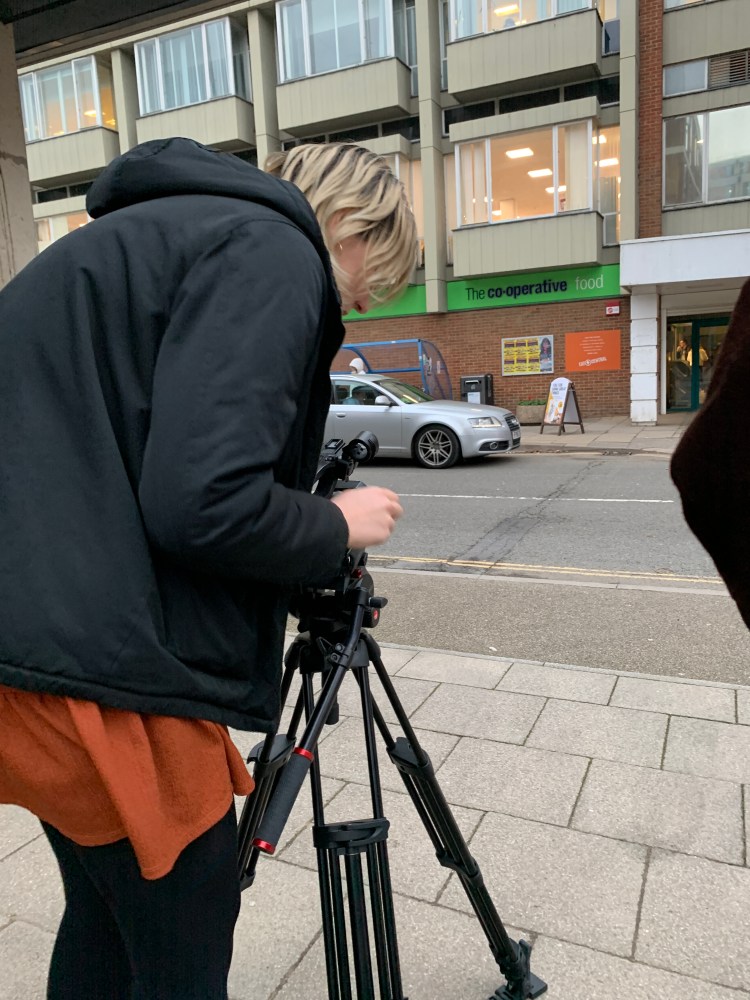
In our second session, we were able to familiarise ourselves with the essential camera equipment. Specifically, in our groups, we set up the Manfrotto 504HD 546BK Tripod and placed the Sony PXW-Z150 Camcorder on-top of it. Together, we adjusted the tripod height and tilt. Then, we were taught the basic functions of the camera. I had never used a camcorder such as this before, so it was definitely a new experience. We learnt how to change aperture, ISO and shutter speed – which actually differed alot from what I’m used to with my Canon 1300D. It relied more on practical changes, yet seemed alot more easier to do in a short space of time. We also looked at the zoom function and how to simply turn it on and record.

To practically set in our knowledge, and get used to working with the camera, our groups went out to record simple cut away footage for our 1 minute short on ‘The Pitfalls of Student Living’. My group has decided to focus on exposing the Co-Operative on campus, for its extortionate prices. Our cutaways included various mid to long shots of the outside Co-Op signs, from various places on campus where it is visible. We used slow zooms alot as well.

1. Some Ways To Think About Documentary and Directing the Documentary

1st. McLane, B & Ellis J. ‘Some Ways To Think About Documentary.’

  1. Subjects – usually specific and factual, focusing on public affairs in an actual and contemporary way.
  2. Purpose or Viewpoints – aim to educate or inform in an informal matter, to prompt new action, thoughts or opinions from audience members
  3. Forms – ‘extract and rearrange’ what already exsists, rather than making up content
  4. Production Methods and Techniques – non-actors, shooting on location, unpurposeful lighting. all add to the sense of actual being created
  5. Audience Experience – an aesthetic experience or an effect on attitudes, should please and instruct, its a reaction not to the filmmaker but the subject matter

2nd. Rabiger, M. ‘What is Documentary?’

The initial chapter on ‘What is Documentary?’ explored the various forms documentary is able to take – from Documentary as socially critical to Documentary as a social art. It furthered my knowledge to how extensive the media practice is, and how broad its creative use is. Documentaries are able to comment on practically anything, due to its flexible means of creation. I specifically found the idea of the genre as ‘fidelity to the actual versus realism’ really interesting, as it questioned the actuality and nature of documentary, posing questions related to the mediums work at questioning reality and human nature.

‘To make documentary is to practice living your life existentially, as though eachday were your last. People who make documentaries put a high value on the joy, pain, compromise, and learning that come from being completely alive.’

I believe documentary is wholly reflective, especially when focusing on humans and our conditions as subjects. It prompts an audience to consider other means of living and ideals. On the whole, to create documentary, you have to consider each point of view and perspective.I find the crisis of existential to be really interesting, and in my personal opinion, to create film, you have to be able to critically evaluate every day and moment. It is from that true experience arrises.

A Documentary can be controlled and premeditated, spontaneous and unpredictable, lyrical and impressionistic, or starkly observational. It can have commentary or no speech at all, interrogate its subjects, catalyse change, or even ambush its subjects. It can impose an order by using words, images, music, or human behaviour. It can use literary, theatrical, or oral traditions and partake of music, painting, song, essay, or choreography.

At the end of the day, art is subjective. It comes in a variety of forms and medias. With Documentary, it is such a creative medium to explore a variety of topics and people, and it is essentially up to the filmmaker to chose how this is portrayed – and how to get their message across best. I really enjoy the creative side to it, as most people can assume that the genre is purely factual and thought provoking. It instead can be as creative and artistic as a full art house film.
Session 1

‘Documentary is the creative treatment of actuality’.

John Grierson

In the initial session, we looked at Documentary on the whole – with a brief look at what is actually is, the history of it, and some key typical conventions of the genre. Previously to this course, I had looked at documentary quite a bit in my A Level Film Studies, and am familiar with the six modes of documentary.

  1. Expository – ‘voice of god’ usually present, educational and informative, typically highly factual rather than opinion based. most commonly seen/popular mode of documentary
  2. Observational – aka cinema verité, ‘fly-on-the-wall’ aspect, filming the subjects with little intervention or intrusion, tries to create a sense of natural actuality
  3. Performative – emotionally and personally driven by the filmmaker themselves, showing a subjective truth or perspective, typically they are heavily influenced by the filmmaker, direct politcal or historical motivation behind it
  4. Poetic – non-linear and lacking clear narrative, subjective interpretation based on the inner truth
  5. Participatory – filmmaker plays an active, on-screen role, involving themselves directly with the subject matter, they play an important, intergral part to the documentary
  6. Reflexive – explores how documentary is constructed, and the actuality of truth in the medium, with acknowledgement that it is a film, breaks the fourth wall.

I have a brief knowledge of the history of Documentary as well.

The 1922 short ‘Nanook of the North’ by Robert Flaherty is considered to be the first official documentary. It openly observes and showcases the simplistic lifestyle of Eskimos he had made friends with, which he wanted to show to people from back home. This defined the ‘observation of actuality’ associated with the genre. However, people have argued that perhaps some of the first moving image films by The Lumière brothers (such as ‘Train Arriving into a Station’) could be considered documentaries. As they are purely a recording of a thing that happened, making them what the Luminere’s called ‘actualities’.

I am looking forward to exploring documentary at a focused level, as I have always been interested in the genre. A few of my favourites include Blackfish and , which both changed the way I view certain aspects in my everyday life and values and morals I have. I think Documentary is a very powerful media, with the four tendencies I know being to record, reveal or preserve, to persuade or promote, to analyse or interrogate, and to express. I am excited to see where my group’s project ends up going and which route we decide to take with our documentary.

Design a site like this with WordPress.com
Get started